OntoGSN
Release: 2025-02-20
- Modified on: 2026-11-05
- This version:
- https://w3id.org/OntoGSN/ontology/1.3.0
- Previous version:
- https://w3id.org/OntoGSN/ontology/1.2.3
- Revision:
- 1.3.0
- Issued on:
- 2026-11-05
- Authors:
- Tomas Bueno Momčilović
- Contributors:
- Barbara Gallina
- Dian Balta
- Ingmar Kessler
- Jule Hendricks
- Publisher:
- fortiss GmbH
- Source:
- https://scsc.uk/SCSC-141C
- See also:
- https://doi.org/10.48550/arXiv.2506.11023
- Download serialization:


- License:

- Visualization:

- Cite as:
- Bueno Momčilović, T. (2026). OntoGSN (Version 1.3.0) [Ontology]. https://doi.org/10.5281/zenodo.17808330
- DOI:

OntoGSN: Overview back to ToC
This ontology has the following classes and properties.Classes
- Argument
- Artefact
- Artefact Reference
- Assumption
- Assurance Case
- Catalogue
- Context
- Defeater
- Goal
- GSN Element
- Instantiation Data Reference
- Justification
- Module
- Pattern
- Relationship
- Relationship with Confidence
- Solution
- Strategy
- Template
- View
Object Properties
- associated with
- attached to
- challenges
- consistent with
- contains
- depicts
- in context of
- in module
- instantiation of
- refers to
- related to
- substituted by
- supported by
- transitively challenges
- transitively in context of
- transitively supported by
Data Properties
- argument type
- assurance claim point
- away
- choice
- contract
- defeated
- final
- in doubt
- maximum cardinality
- minimum cardinality
- multiple
- off-diagram
- optional
- public
- published
- relationship type
- statement
- structured
- to be supported by contract
- top (goal)
- true
- undeveloped
- uninstantiated
- valid
- view type
Annotation Properties
- abstract
- alt Label
- applicability
- bibliographic Citation
- citation
- collaboration
- consequences
- contributor
- core or extension
- created
- creator
- definition
- description
- description
- disclaimer
- doi
- examples
- implementation
- included In Data Catalog
- inferred only
- intent
- is Rule Enabled
- issued
- known uses
- license
- license
- logo
- modified
- motivation
- name
- note
- participants
- preferred Namespace Prefix
- preferred Namespace Uri
- publisher
- rendered as
- scope Note
- source
- status
- structure
- title
- url
SWRL Rules
- Assumption False Propagation
- Assumption Invalidation
- Away Goal Invalidation
- Challenge Chain Invalidation
- Challenge Closure
- Challenge Cycle Invalidation
- Challenge Cycle Relationship Invalidation
- Challenge Defeat
- Challenge Doubt
- Challenge Relation Creation
- Confidence Relation Creation
- Context Consistency
- Context Contract Invalidation
- Context Inheritance
- Context Relation Creation
- Contextual Relation
- Contract Activation
- Contract Relation Invalidation
- Contract Support Invalidation
- Contract Violation Relation
- Contradictory Goal Truth
- Cross-Module Away Context
- Cross-Module Away Support
- Cross-Module Support
- Defeated Invalidation
- Defeater Declaration
- Duplicate ACP Identifier Invalidation
- Duplicate Identifier Invalidation
- Evidential Relation
- Final Pattern Invalidation
- Goal Confidence Relation
- Goal Top Flag
- Goal-Strategy Confidence
- Inferential Relation
- Inferential Relation (Goal)
- Mixed Support Invalidation
- Module Context Closure
- Module Context Cycle Invalidation
- Module Context Cycle Relationship Invalidation
- Module Context Propagation
- Module Membership
- Module Support Propagation
- Nested Module Membership
- Public Context Propagation
- Public Contract Invalidation
- Relation False Propagation
- Solution Confidence Relation
- Solution Propagation (False)
- Solution Propagation (True)
- Strategy Confidence Relation
- Substitution Invalidation
- Support Closure
- Support Cycle Invalidation
- Support Cycle Relationship Invalidation
- Support Relation Creation
- Template Undeveloped Invalidation (A)
- Template Undeveloped Invalidation (B)
- Undeveloped Defeat
OntoGSN: Description back to ToC
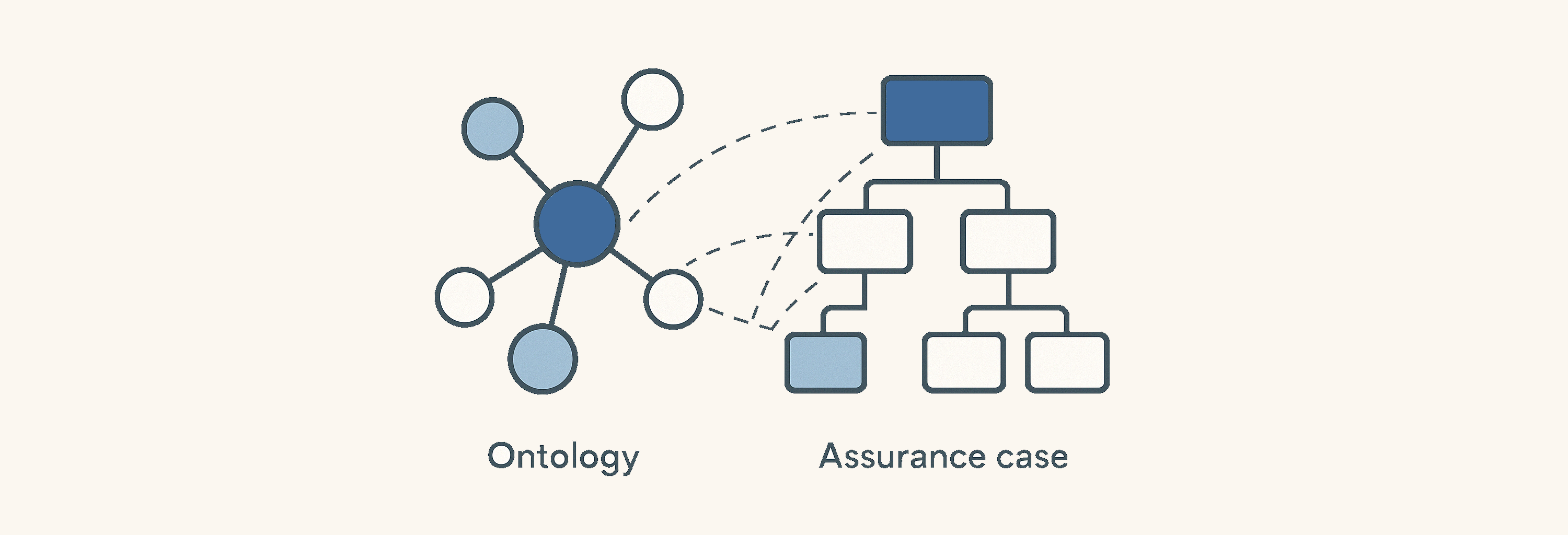
OntoGSN is an ontology for managing assurance cases in the Goal Structuring Notation (GSN). The goal of the ontology is to help users in linking the elements of their cases - claims and evidence - with the internationalized resource identifiers (IRIs) of represented concepts, events and data, and in evaluating the validity of their argument.Cross-reference for OntoGSN classes, object properties and data properties back to ToC
This section provides details for each class and property defined by OntoGSN.Classes
- Argument
- Artefact
- Artefact Reference
- Assumption
- Assurance Case
- Catalogue
- Context
- Defeater
- Goal
- GSN Element
- Instantiation Data Reference
- Justification
- Module
- Pattern
- Relationship
- Relationship with Confidence
- Solution
- Strategy
- Template
- View
Argumentc back to ToC or Class ToC
IRI: https://w3id.org/OntoGSN/ontology#Argument
- has super-classes
- is in domain of
- argument type dp, contains op, final dp, instantiation of op, published dp, statement dp, structured dp, valid dp
- is in range of
- associated with op, contains op
Artefactc back to ToC or Class ToC
IRI: https://w3id.org/OntoGSN/ontology#Artefact
Artefact Referencec back to ToC or Class ToC
IRI: https://w3id.org/OntoGSN/ontology#ArtefactReference
- has super-classes
- GSN Element c
- has sub-classes
- Context c, Solution c
- is in domain of
- associated with op, assurance claim point dp, refers to op
Assumptionc back to ToC or Class ToC
IRI: https://w3id.org/OntoGSN/ontology#Assumption
- has super-classes
- GSN Element c
- is in domain of
- away dp, consistent with op, public dp
- is in range of
- consistent with op, in context of op
Assurance Casec back to ToC or Class ToC
IRI: https://w3id.org/OntoGSN/ontology#AssuranceCase
Cataloguec back to ToC or Class ToC
IRI: https://w3id.org/OntoGSN/ontology#Catalogue
- has super-classes
- is in domain of
- contains op
Contextc back to ToC or Class ToC
IRI: https://w3id.org/OntoGSN/ontology#Context
- has super-classes
- Artefact Reference c
- is in domain of
- away dp, consistent with op, public dp
- is in range of
- consistent with op, in context of op
Defeaterc back to ToC or Class ToC
IRI: https://w3id.org/OntoGSN/ontology#Defeater
- has super-classes
Goalc back to ToC or Class ToC
IRI: https://w3id.org/OntoGSN/ontology#Goal
- has super-classes
- GSN Element c
- is in domain of
- away dp, challenges op, in context of op, public dp, supported by op, to be supported by contract dp, top (goal) dp, undeveloped dp
- is in range of
- supported by op
GSN Elementc back to ToC or Class ToC
IRI: https://w3id.org/OntoGSN/ontology#GSNElement
- has super-classes
- has sub-classes
- Artefact Reference c, Assumption c, Goal c, Justification c, Module c, Strategy c
- is in domain of
- defeated dp, in doubt dp, in module op, instantiation of op, off-diagram dp, statement dp, transitively challenges op, transitively supported by op, true dp, uninstantiated dp, valid dp
- is in range of
- attached to op, challenges op, contains op, transitively challenges op, transitively supported by op
Instantiation Data Referencec back to ToC or Class ToC
IRI: https://w3id.org/OntoGSN/ontology#InstantiationDataReference
- is in domain of
- attached to op, refers to op
Justificationc back to ToC or Class ToC
IRI: https://w3id.org/OntoGSN/ontology#Justification
- has super-classes
- GSN Element c
- is in domain of
- away dp, public dp, substituted by op
- is in range of
- in context of op
Modulec back to ToC or Class ToC
IRI: https://w3id.org/OntoGSN/ontology#Module
- has super-classes
- GSN Element c
- is in domain of
- contains op, contract dp, in context of op, supported by op, transitively in context of op
- is in range of
- depicts op, in context of op, in module op, supported by op, transitively in context of op
Patternc back to ToC or Class ToC
IRI: https://w3id.org/OntoGSN/ontology#Pattern
- has super-classes
- has sub-classes
- Template c
- is in domain of
- applicability ap, collaboration ap, consequences ap, contains op, examples ap, final dp, implementation ap, intent ap, known uses ap, motivation ap, participants ap, published dp, related to op, structure ap, valid dp
- is in range of
- contains op, instantiation of op, related to op
Relationshipc back to ToC or Class ToC
IRI: https://w3id.org/OntoGSN/ontology#Relationship
- has super-classes
- Statement c
- has sub-classes
- Relationship with Confidence c
- is in domain of
- choice dp, defeated dp, in doubt dp, maximum cardinality dp, minimum cardinality dp, multiple dp, optional dp, relationship type dp, transitively challenges op, true dp, undeveloped dp, valid dp
- is in range of
- challenges op, transitively challenges op
Relationship with Confidencec back to ToC or Class ToC
IRI: https://w3id.org/OntoGSN/ontology#RelationshipWithConfidence
- has super-classes
- Relationship c
- is in domain of
- associated with op, assurance claim point dp
Solutionc back to ToC or Class ToC
IRI: https://w3id.org/OntoGSN/ontology#Solution
- has super-classes
- Artefact Reference c
- is in domain of
- away dp, challenges op, public dp
- is in range of
- supported by op
Strategyc back to ToC or Class ToC
IRI: https://w3id.org/OntoGSN/ontology#Strategy
- has super-classes
- GSN Element c
- is in domain of
- in context of op, supported by op, undeveloped dp
- is in range of
- supported by op
Templatec back to ToC or Class ToC
IRI: https://w3id.org/OntoGSN/ontology#Template
- has super-classes
- Pattern c
- is in range of
- attached to op
Object Properties
- associated with
- attached to
- challenges
- consistent with
- contains
- depicts
- in context of
- in module
- instantiation of
- refers to
- related to
- substituted by
- supported by
- transitively challenges
- transitively in context of
- transitively supported by
associated withop back to ToC or Object Property ToC
IRI: https://w3id.org/OntoGSN/ontology#associatedWith
- has domain
- Artefact Reference c or Relationship with Confidence c
- has range
- Argument c
attached toop back to ToC or Object Property ToC
IRI: https://w3id.org/OntoGSN/ontology#attachedTo
- has domain
- Instantiation Data Reference c
- has range
- GSN Element c or Template c
challengesop back to ToC or Object Property ToC
IRI: https://w3id.org/OntoGSN/ontology#challenges
- has domain
- Goal c or Solution c
- has range
- GSN Element c or Relationship c
consistent withop back to ToC or Object Property ToC
IRI: https://w3id.org/OntoGSN/ontology#consistentWith
has characteristics: symmetric
- has domain
- Assumption c or Context c
- has range
- Assumption c or Context c
containsop back to ToC or Object Property ToC
IRI: https://w3id.org/OntoGSN/ontology#contains
- has domain
- Argument c or Assurance Case c or Catalogue c or Module c or Pattern c
- has range
- Argument c or Artefact c or GSN Element c or Pattern c
depictsop back to ToC or Object Property ToC
IRI: https://w3id.org/OntoGSN/ontology#depicts
in context ofop back to ToC or Object Property ToC
IRI: https://w3id.org/OntoGSN/ontology#inContextOf
has characteristics: asymmetric, irreflexive
- has domain
- Goal c or Module c or Strategy c
- has range
- Assumption c or Context c or Justification c or Module c
in moduleop back to ToC or Object Property ToC
IRI: https://w3id.org/OntoGSN/ontology#inModule
- has domain
- GSN Element c
- has range
- Module c
instantiation ofop back to ToC or Object Property ToC
IRI: https://w3id.org/OntoGSN/ontology#instantiationOf
- has domain
- Argument c or GSN Element c
- has range
- Pattern c
refers toop back to ToC or Object Property ToC
IRI: https://w3id.org/OntoGSN/ontology#refersTo
- has domain
- Artefact Reference c or Instantiation Data Reference c
- has range
- Artefact c
substituted byop back to ToC or Object Property ToC
IRI: https://w3id.org/OntoGSN/ontology#substitutedBy
- has domain
- Justification c
- has range
- Goal c and (away dp value true)
supported byop back to ToC or Object Property ToC
IRI: https://w3id.org/OntoGSN/ontology#supportedBy
transitively challengesop back to ToC or Object Property ToC
IRI: https://w3id.org/OntoGSN/ontology#transitivelyChallenges
has characteristics: transitive
- has domain
- GSN Element c or Relationship c
- has range
- GSN Element c or Relationship c
transitively in context ofop back to ToC or Object Property ToC
IRI: https://w3id.org/OntoGSN/ontology#transitivelyInContextOf
transitively supported byop back to ToC or Object Property ToC
IRI: https://w3id.org/OntoGSN/ontology#transitivelySupportedBy
has characteristics: transitive
- has domain
- GSN Element c
- has range
- GSN Element c
Data Properties
- argument type
- assurance claim point
- away
- choice
- contract
- defeated
- final
- in doubt
- maximum cardinality
- minimum cardinality
- multiple
- off-diagram
- optional
- public
- published
- relationship type
- statement
- structured
- to be supported by contract
- top (goal)
- true
- undeveloped
- uninstantiated
- valid
- view type
argument typedp back to ToC or Data Property ToC
IRI: https://w3id.org/OntoGSN/ontology#argumentType
- has domain
- Argument c
- has range
- { "confidence" , "dialectic" , "risk" }
assurance claim pointdp back to ToC or Data Property ToC
IRI: https://w3id.org/OntoGSN/ontology#assuranceClaimPoint
- has domain
- Artefact Reference c or Relationship with Confidence c
- has range
- boolean
awaydp back to ToC or Data Property ToC
IRI: https://w3id.org/OntoGSN/ontology#away
- has domain
- Assumption c or Context c or Goal c or Justification c or Solution c
- has range
- boolean
choicedp back to ToC or Data Property ToC
IRI: https://w3id.org/OntoGSN/ontology#choice
- has domain
- Relationship c
- has range
- boolean
contractdp back to ToC or Data Property ToC
IRI: https://w3id.org/OntoGSN/ontology#contract
defeateddp back to ToC or Data Property ToC
IRI: https://w3id.org/OntoGSN/ontology#defeated
- has domain
- GSN Element c or Relationship c
- has range
- boolean
finaldp back to ToC or Data Property ToC
IRI: https://w3id.org/OntoGSN/ontology#final
in doubtdp back to ToC or Data Property ToC
IRI: https://w3id.org/OntoGSN/ontology#inDoubt
- has domain
- Assurance Case c or GSN Element c or Relationship c
- has range
- boolean
maximum cardinalitydp back to ToC or Data Property ToC
IRI: https://w3id.org/OntoGSN/ontology#maxCardinality
- has domain
- Relationship c
- has range
- non Negative Integer
minimum cardinalitydp back to ToC or Data Property ToC
IRI: https://w3id.org/OntoGSN/ontology#minCardinality
- has domain
- Relationship c
- has range
- non Negative Integer
multipledp back to ToC or Data Property ToC
IRI: https://w3id.org/OntoGSN/ontology#multiple
- has domain
- Relationship c
- has range
- boolean
off-diagramdp back to ToC or Data Property ToC
IRI: https://w3id.org/OntoGSN/ontology#offDiagram
- has domain
- GSN Element c
- has range
- boolean
optionaldp back to ToC or Data Property ToC
IRI: https://w3id.org/OntoGSN/ontology#optional
- has domain
- Relationship c
- has range
- boolean
publicdp back to ToC or Data Property ToC
IRI: https://w3id.org/OntoGSN/ontology#public
- has domain
- Assumption c or Context c or Goal c or Justification c or Solution c
- has range
- boolean
publisheddp back to ToC or Data Property ToC
IRI: https://w3id.org/OntoGSN/ontology#published
relationship typedp back to ToC or Data Property ToC
IRI: https://w3id.org/OntoGSN/ontology#relationshipType
- has domain
- Relationship c
- has range
- { "contextual" , "dialectic" , "evidential" , "inferential" }
statementdp back to ToC or Data Property ToC
IRI: https://w3id.org/OntoGSN/ontology#statement
- has domain
- Argument c or Assurance Case c or GSN Element c
- has range
- string
structureddp back to ToC or Data Property ToC
IRI: https://w3id.org/OntoGSN/ontology#structured
to be supported by contractdp back to ToC or Data Property ToC
IRI: https://w3id.org/OntoGSN/ontology#toBeSupportedByContract
top (goal)dp back to ToC or Data Property ToC
IRI: https://w3id.org/OntoGSN/ontology#top
truedp back to ToC or Data Property ToC
IRI: https://w3id.org/OntoGSN/ontology#true
- has domain
- GSN Element c or Relationship c
- has range
- boolean
undevelopeddp back to ToC or Data Property ToC
IRI: https://w3id.org/OntoGSN/ontology#undeveloped
- has domain
- Goal c or Relationship c or Strategy c
- has range
- boolean
uninstantiateddp back to ToC or Data Property ToC
IRI: https://w3id.org/OntoGSN/ontology#uninstantiated
- has domain
- GSN Element c
- has range
- boolean
validdp back to ToC or Data Property ToC
IRI: https://w3id.org/OntoGSN/ontology#valid
- has domain
- Argument c or GSN Element c or Pattern c or Relationship c
- has range
- boolean
view typedp back to ToC or Data Property ToC
IRI: https://w3id.org/OntoGSN/ontology#viewType
- has domain
- View c
- has range
- { "architecture" , "argument" }
Annotation Properties
- abstract
- alt Label
- applicability
- bibliographic Citation
- citation
- collaboration
- consequences
- contributor
- core or extension
- created
- creator
- definition
- description
- description
- disclaimer
- doi
- examples
- implementation
- included In Data Catalog
- inferred only
- intent
- is Rule Enabled
- issued
- known uses
- license
- license
- logo
- modified
- motivation
- name
- note
- participants
- preferred Namespace Prefix
- preferred Namespace Uri
- publisher
- rendered as
- scope Note
- source
- status
- structure
- title
- url
abstractap back to ToC or Annotation Property ToC
IRI: http://purl.org/dc/terms/abstract
alt Labelap back to ToC or Annotation Property ToC
IRI: http://www.w3.org/2004/02/skos/core#altLabel
applicabilityap back to ToC or Annotation Property ToC
IRI: https://w3id.org/OntoGSN/ontology#applicability
- has domain
- Pattern c
bibliographic Citationap back to ToC or Annotation Property ToC
IRI: http://purl.org/dc/terms/bibliographicCitation
citationap back to ToC or Annotation Property ToC
IRI: http://schema.org/citation
collaborationap back to ToC or Annotation Property ToC
IRI: https://w3id.org/OntoGSN/ontology#collaboration
- has domain
- Pattern c
consequencesap back to ToC or Annotation Property ToC
IRI: https://w3id.org/OntoGSN/ontology#consequences
- has domain
- Pattern c
contributorap back to ToC or Annotation Property ToC
IRI: http://purl.org/dc/elements/1.1/contributor
core or extensionap back to ToC or Annotation Property ToC
IRI: https://w3id.org/OntoGSN/ontology#coreOrExtension
createdap back to ToC or Annotation Property ToC
IRI: http://purl.org/dc/terms/created
creatorap back to ToC or Annotation Property ToC
IRI: http://purl.org/dc/elements/1.1/creator
definitionap back to ToC or Annotation Property ToC
IRI: http://www.w3.org/2004/02/skos/core#definition
descriptionap back to ToC or Annotation Property ToC
IRI: http://purl.org/dc/elements/1.1/description
descriptionap back to ToC or Annotation Property ToC
IRI: http://schema.org/description
- is also defined as
- data property
disclaimerap back to ToC or Annotation Property ToC
IRI: http://schema.org/disclaimer
doiap back to ToC or Annotation Property ToC
IRI: http://purl.org/ontology/bibo/doi
examplesap back to ToC or Annotation Property ToC
IRI: https://w3id.org/OntoGSN/ontology#examples
- has domain
- Pattern c
implementationap back to ToC or Annotation Property ToC
IRI: https://w3id.org/OntoGSN/ontology#implementation
- has domain
- Pattern c
included In Data Catalogap back to ToC or Annotation Property ToC
IRI: http://schema.org/includedInDataCatalog
inferred onlyap back to ToC or Annotation Property ToC
IRI: https://w3id.org/OntoGSN/ontology#inferredOnly
intentap back to ToC or Annotation Property ToC
IRI: https://w3id.org/OntoGSN/ontology#intent
- has domain
- Pattern c
is Rule Enabledap back to ToC or Annotation Property ToC
IRI: http://swrl.stanford.edu/ontologies/3.3/swrla.owl#isRuleEnabled
issuedap back to ToC or Annotation Property ToC
IRI: http://purl.org/dc/terms/issued
known usesap back to ToC or Annotation Property ToC
IRI: https://w3id.org/OntoGSN/ontology#knownUses
- has domain
- Pattern c
licenseap back to ToC or Annotation Property ToC
IRI: http://creativecommons.org/ns#license
licenseap back to ToC or Annotation Property ToC
IRI: http://schema.org/license
logoap back to ToC or Annotation Property ToC
IRI: http://schema.org/logo
modifiedap back to ToC or Annotation Property ToC
IRI: http://purl.org/dc/terms/modified
motivationap back to ToC or Annotation Property ToC
IRI: https://w3id.org/OntoGSN/ontology#motivation
- has domain
- Pattern c
nameap back to ToC or Annotation Property ToC
IRI: http://schema.org/name
noteap back to ToC or Annotation Property ToC
IRI: http://www.w3.org/2004/02/skos/core#note
participantsap back to ToC or Annotation Property ToC
IRI: https://w3id.org/OntoGSN/ontology#participants
- has domain
- Pattern c
preferred Namespace Prefixap back to ToC or Annotation Property ToC
IRI: http://purl.org/vocab/vann/preferredNamespacePrefix
preferred Namespace Uriap back to ToC or Annotation Property ToC
IRI: http://purl.org/vocab/vann/preferredNamespaceUri
publisherap back to ToC or Annotation Property ToC
IRI: http://purl.org/dc/elements/1.1/publisher
rendered asap back to ToC or Annotation Property ToC
IRI: https://w3id.org/OntoGSN/ontology#renderedAs
scope Noteap back to ToC or Annotation Property ToC
IRI: http://www.w3.org/2004/02/skos/core#scopeNote
sourceap back to ToC or Annotation Property ToC
IRI: http://purl.org/dc/elements/1.1/source
statusap back to ToC or Annotation Property ToC
IRI: http://purl.org/ontology/bibo/status
structureap back to ToC or Annotation Property ToC
IRI: https://w3id.org/OntoGSN/ontology#structure
- has domain
- Pattern c
titleap back to ToC or Annotation Property ToC
IRI: http://purl.org/dc/elements/1.1/title
urlap back to ToC or Annotation Property ToC
IRI: http://schema.org/url
SWRL rules
- Assumption False Propagation
- Assumption Invalidation
- Away Goal Invalidation
- Challenge Chain Invalidation
- Challenge Closure
- Challenge Cycle Invalidation
- Challenge Cycle Relationship Invalidation
- Challenge Defeat
- Challenge Doubt
- Challenge Relation Creation
- Confidence Relation Creation
- Context Consistency
- Context Contract Invalidation
- Context Inheritance
- Context Relation Creation
- Contextual Relation
- Contract Activation
- Contract Relation Invalidation
- Contract Support Invalidation
- Contract Violation Relation
- Contradictory Goal Truth
- Cross-Module Away Context
- Cross-Module Away Support
- Cross-Module Support
- Defeated Invalidation
- Defeater Declaration
- Duplicate ACP Identifier Invalidation
- Duplicate Identifier Invalidation
- Evidential Relation
- Final Pattern Invalidation
- Goal Confidence Relation
- Goal Top Flag
- Goal-Strategy Confidence
- Inferential Relation
- Inferential Relation (Goal)
- Mixed Support Invalidation
- Module Context Closure
- Module Context Cycle Invalidation
- Module Context Cycle Relationship Invalidation
- Module Context Propagation
- Module Membership
- Module Support Propagation
- Nested Module Membership
- Public Context Propagation
- Public Contract Invalidation
- Relation False Propagation
- Solution Confidence Relation
- Solution Propagation (False)
- Solution Propagation (True)
- Strategy Confidence Relation
- Substitution Invalidation
- Support Closure
- Support Cycle Invalidation
- Support Cycle Relationship Invalidation
- Support Relation Creation
- Template Undeveloped Invalidation (A)
- Template Undeveloped Invalidation (B)
- Undeveloped Defeat
Assumption False Propagationback to ToC or SWRL ToC
Assumption c(?A) , true dp(?A,"false"^^boolean) , in context of op(?B,?A) -> true dp(?B,"false"^^boolean)
Assumption Invalidationback to ToC or SWRL ToC
Assumption c(?A) , valid dp(?A,"false"^^boolean) , in context of op(?B,?A) -> valid dp(?B,"false"^^boolean)
Away Goal Invalidationback to ToC or SWRL ToC
subject op(?R,?G1) , Module c(?M1) , Goal c(?G1) , object op(?R,?G2) , Module c(?M2) , supported by op(?G1,?G2) , away dp(?G1,"true"^^boolean) , in module op(?G1,?M1) , in module op(?G2,?M2) -> valid dp(?R,"false"^^boolean)
Challenge Chain Invalidationback to ToC or SWRL ToC
challenges op(?D,?R) , subject op(?R,?G3) , object op(?R,?G1) , Goal c(?G1) , Goal c(?G3) , makeOWLThing(?S,?G3) , Goal c(?G2) , supported by op(?G3,?G1) , supported by op(?G3,?G2) , DifferentFrom(?G1,?G2) -> supported by op(?S,?G2) , supported by op(?G3,?S) , valid dp(?D,"false"^^boolean) , supported by op(?S,?G1) , challenges op(?D,?S) , valid dp(?S,"false"^^boolean) , valid dp(?R,"false"^^boolean) , Strategy c(?S)
Challenge Closureback to ToC or SWRL ToC
challenges op(?A,?B) -> transitively challenges op(?A,?B)
Challenge Cycle Invalidationback to ToC or SWRL ToC
transitively challenges op(?E,?E) -> valid dp(?E,"false"^^boolean)
Challenge Cycle Relationship Invalidationback to ToC or SWRL ToC
Relationship c(?R) , subject op(?R,?A) , object op(?R,?B) , challenges op(?A,?B) , transitively challenges op(?B,?A) -> valid dp(?R,"false"^^boolean)
Challenge Defeatback to ToC or SWRL ToC
valid dp(?S,"true"^^boolean) , challenges op(?S,?E) , Solution c(?S) -> defeated dp(?E,"true"^^boolean)
Challenge Doubtback to ToC or SWRL ToC
challenges op(?G,?E) , true dp(?G,"true"^^boolean) , Goal c(?G) -> in doubt dp(?E,"true"^^boolean)
Challenge Relation Creationback to ToC or SWRL ToC
challenges op(?A,?B) , makeOWLThing(?R,?A,?B) -> subject op(?R,?A) , Relationship c(?R) , object op(?R,?B) , relationship type dp(?R,"dialectic")
Confidence Relation Creationback to ToC or SWRL ToC
assurance claim point dp(?A,"true"^^boolean) , Artefact Reference c(?A) , makeOWLThing(?R,?A) -> Relationship with Confidence c(?R) , subject op(?R,?A) , assurance claim point dp(?R,"true"^^boolean)
Context Consistencyback to ToC or SWRL ToC
in context of op(?G1,?C1) , in context of op(?G2,?C2) , Goal c(?G1) , Goal c(?G2) , away dp(?G2,"true"^^boolean) , supported by op(?G1,?G2) , Context c(?C2) -> consistent with op(?C1,?C2)
Context Contract Invalidationback to ToC or SWRL ToC
in context of op(?A,?M1) , object op(?R,?M1) , Module c(?M1) , Module c(?M2) , contains op(?M2,?A) , subject op(?R,?A) , contract dp(?M2,"true"^^boolean) -> valid dp(?R,"false"^^boolean)
Context Inheritanceback to ToC or SWRL ToC
supported by op(?B,?C) , in context of op(?B,?A) , Assumption c(?A) , Goal c(?C) -> in context of op(?C,?A)
Context Relation Creationback to ToC or SWRL ToC
in context of op(?A,?B) , makeOWLThing(?R,?A,?B) -> subject op(?R,?A) , Relationship c(?R) , object op(?R,?B)
Contextual Relationback to ToC or SWRL ToC
subject op(?R,?A) , in context of op(?A,?B) , object op(?R,?B) -> relationship type dp(?R,"contextual")
Contract Activationback to ToC or SWRL ToC
away dp(?A,"true"^^boolean) , to be supported by contract dp(?A,"true"^^boolean) , Module c(?M1) , Module c(?M2) , in module op(?A,?M1) , in module op(?B,?M2) , supported by op(?A,?B) , DifferentFrom(?M1,?M2) -> contract dp(?M2,"true"^^boolean)
Contract Relation Invalidationback to ToC or SWRL ToC
contains op(?M,?B) , contains op(?M,?A) , to be supported by contract dp(?A,"true"^^boolean) , supported by op(?A,?B) , subject op(?R,?A) , Module c(?M) , object op(?R,?B) -> valid dp(?R,"false"^^boolean)
Contract Support Invalidationback to ToC or SWRL ToC
contains op(?M,?A) , to be supported by contract dp(?A,"true"^^boolean) , contract dp(?M,"true"^^boolean) , Module c(?M) -> valid dp(?A,"false"^^boolean)
Contract Violation Relationback to ToC or SWRL ToC
object op(?R,?M1) , Module c(?M1) , Module c(?M2) , contains op(?M2,?A) , supported by op(?A,?M1) , subject op(?R,?A) , contract dp(?M2,"true"^^boolean) -> valid dp(?R,"false"^^boolean)
Contradictory Goal Truthback to ToC or SWRL ToC
true dp(?A,"false"^^boolean) , true dp(?B,"true"^^boolean) , supported by op(?B,?A) , Goal c(?A) -> valid dp(?B,"false"^^boolean)
Cross-Module Away Contextback to ToC or SWRL ToC
in module op(?A,?M) , in module op(?B,?N) , Module c(?N) , in context of op(?A,?B) , Module c(?M) , DifferentFrom(?M,?N) -> away dp(?B,"true"^^boolean)
Cross-Module Away Supportback to ToC or SWRL ToC
in module op(?A,?M) , in module op(?B,?N) , supported by op(?A,?B) , Module c(?N) , Module c(?M) , DifferentFrom(?M,?N) -> away dp(?B,"true"^^boolean)
Cross-Module Supportback to ToC or SWRL ToC
supported by op(?E1,?M2) , Module c(?M1) , Module c(?M2) , in module op(?E1,?M1) , DifferentFrom(?M1,?M2) -> supported by op(?M1,?M2)
Defeated Invalidationback to ToC or SWRL ToC
defeated dp(?E,"true"^^boolean) -> valid dp(?E,"false"^^boolean)
Defeater Declarationback to ToC or SWRL ToC
challenges op(?A,?B) -> Defeater c(?A)
Duplicate ACP Identifier Invalidationback to ToC or SWRL ToC
assurance claim point dp(?A,"true"^^boolean) , assurance claim point dp(?B,"true"^^boolean) , identifier dp(?A,?N) , identifier dp(?B,?N) , DifferentFrom(?A,?B) -> valid dp(?A,"false"^^boolean) , valid dp(?B,"false"^^boolean)
Duplicate Identifier Invalidationback to ToC or SWRL ToC
contains op(?M,?B) , contains op(?M,?A) , identifier dp(?A,?ID) , Module c(?M) , DifferentFrom(?A,?B) , identifier dp(?B,?ID) -> valid dp(?A,"false"^^boolean) , valid dp(?B,"false"^^boolean)
Evidential Relationback to ToC or SWRL ToC
Solution c(?B) , supported by op(?A,?B) , subject op(?R,?A) , object op(?R,?B) -> relationship type dp(?R,"evidential")
Final Pattern Invalidationback to ToC or SWRL ToC
instantiation of op(?B,?C) , final dp(?A,"true"^^boolean) , Pattern c(?C) , contains op(?A,?B) , contains op(?A,?C) -> valid dp(?A,"false"^^boolean)
Goal Confidence Relationback to ToC or SWRL ToC
supported by op(?G,?S2) , Goal c(?S1) , object op(?R1,?S1) , Relationship with Confidence c(?R1) , makeOWLThing(?R2,?G,?S2) , supported by op(?G,?S1) , Goal c(?S2) , Goal c(?G) , DifferentFrom(?S1,?S2) , associated with op(?R1,?A) , subject op(?R1,?G) -> object op(?R2,?S2) , Relationship with Confidence c(?R2) , subject op(?R2,?G) , associated with op(?R2,?A) , assurance claim point dp(?R2,"true"^^boolean)
Goal Top Flagback to ToC or SWRL ToC
supported by op(?X,?A) , Goal c(?A) -> top (goal) dp(?A,"false"^^boolean)
Goal-Strategy Confidenceback to ToC or SWRL ToC
supported by op(?G2,?S) , Relationship with Confidence c(?R1) , subject op(?R1,?S) , supported by op(?S,?G1) , makeOWLThing(?R2,?G2,?S) , object op(?R1,?G1) , Strategy c(?S) , Goal c(?G1) , Goal c(?G2) , associated with op(?R1,?A) -> Relationship with Confidence c(?R2) , associated with op(?R2,?A) , assurance claim point dp(?R2,"true"^^boolean) , subject op(?R2,?G2) , object op(?R2,?S)
Inferential Relationback to ToC or SWRL ToC
Strategy c(?B) , supported by op(?A,?B) , subject op(?R,?A) , object op(?R,?B) -> relationship type dp(?R,"inferential")
Inferential Relation (Goal)back to ToC or SWRL ToC
supported by op(?A,?B) , subject op(?R,?A) , object op(?R,?B) , Goal c(?B) -> relationship type dp(?R,"inferential")
Mixed Support Invalidationback to ToC or SWRL ToC
valid dp(?B,"false"^^boolean) , valid dp(?A,"true"^^boolean) , supported by op(?C,?B) , supported by op(?C,?A) -> valid dp(?C,"false"^^boolean)
Module Context Closureback to ToC or SWRL ToC
Module c(?A) , Module c(?B) , in context of op(?A,?B) -> transitively in context of op(?A,?B)
Module Context Cycle Invalidationback to ToC or SWRL ToC
transitively in context of op(?M,?M) -> valid dp(?M,"false"^^boolean)
Module Context Cycle Relationship Invalidationback to ToC or SWRL ToC
Relationship c(?R) , subject op(?R,?A) , object op(?R,?B) , in context of op(?A,?B) , transitively in context of op(?B,?A) -> valid dp(?R,"false"^^boolean)
Module Context Propagationback to ToC or SWRL ToC
Module c(?M1) , Module c(?M2) , in module op(?E1,?M1) , in module op(?E2,?M2) , in context of op(?E1,?E2) , DifferentFrom(?M1,?M2) -> in context of op(?M1,?M2)
Module Membershipback to ToC or SWRL ToC
Module c(?M) , contains op(?M,?Arg) , Argument c(?Arg) , contains op(?Arg,?E) , GSN Element c(?E) -> in module op(?E,?M)
Module Support Propagationback to ToC or SWRL ToC
Module c(?M1) , Module c(?M2) , supported by op(?E1,?E2) , in module op(?E1,?M1) , in module op(?E2,?M2) , DifferentFrom(?M1,?M2) -> supported by op(?M1,?M2)
Nested Module Membershipback to ToC or SWRL ToC
Module c(?M) , contains op(?M,?N) , Module c(?N) , in module op(?E,?N) -> in module op(?E,?M)
Public Context Propagationback to ToC or SWRL ToC
public dp(?G,"true"^^boolean) , in context of op(?G,?C) , Goal c(?G) -> public dp(?C,"true"^^boolean)
Public Contract Invalidationback to ToC or SWRL ToC
contract dp(?C,"true"^^boolean) , public dp(?E,"true"^^boolean) , contains op(?C,?E) -> valid dp(?E,"false"^^boolean)
Relation False Propagationback to ToC or SWRL ToC
true dp(?R,"false"^^boolean) , subject op(?R,?A) , in context of op(?A,?B) , Relationship c(?R) , object op(?R,?B) -> true dp(?A,"false"^^boolean)
Solution Confidence Relationback to ToC or SWRL ToC
supported by op(?G,?S2) , Solution c(?S1) , object op(?R1,?S1) , Relationship with Confidence c(?R1) , makeOWLThing(?R2,?G,?S2) , supported by op(?G,?S1) , Goal c(?G) , DifferentFrom(?S1,?S2) , associated with op(?R1,?A) , subject op(?R1,?G) , Solution c(?S2) -> object op(?R2,?S2) , Relationship with Confidence c(?R2) , subject op(?R2,?G) , associated with op(?R2,?A) , assurance claim point dp(?R2,"true"^^boolean)
Solution Propagation (False)back to ToC or SWRL ToC
Solution c(?A) , true dp(?A,"false"^^boolean) , supported by op(?B,?A) -> true dp(?B,"false"^^boolean)
Solution Propagation (True)back to ToC or SWRL ToC
Solution c(?A) , supported by op(?B,?A) , true dp(?A,"true"^^boolean) -> true dp(?B,"true"^^boolean)
Strategy Confidence Relationback to ToC or SWRL ToC
supported by op(?G1,?S) , supported by op(?S,?G2) , Relationship with Confidence c(?R1) , makeOWLThing(?R2,?S,?G2) , Strategy c(?S) , Goal c(?G1) , Goal c(?G2) , object op(?R1,?S) , associated with op(?R1,?A) , subject op(?R1,?G1) -> subject op(?R2,?S) , Relationship with Confidence c(?R2) , object op(?R2,?G2) , associated with op(?R2,?A) , assurance claim point dp(?R2,"true"^^boolean)
Substitution Invalidationback to ToC or SWRL ToC
in module op(?G,?M2) , Module c(?M1) , Module c(?M2) , substituted by op(?J,?G) , in module op(?J,?M1) , Justification c(?J) , in context of op(?E,?J) , DifferentFrom(?M1,?M2) -> valid dp(?J,"false"^^boolean)
Support Closureback to ToC or SWRL ToC
supported by op(?A,?B) -> transitively supported by op(?A,?B)
Support Cycle Invalidationback to ToC or SWRL ToC
transitively supported by op(?E,?E) -> valid dp(?E,"false"^^boolean)
Support Cycle Relationship Invalidationback to ToC or SWRL ToC
Relationship c(?R) , subject op(?R,?A) , object op(?R,?B) , supported by op(?A,?B) , transitively supported by op(?B,?A) -> valid dp(?R,"false"^^boolean)
Support Relation Creationback to ToC or SWRL ToC
supported by op(?A,?B) , makeOWLThing(?R,?A,?B) -> subject op(?R,?A) , Relationship c(?R) , object op(?R,?B)
Template Undeveloped Invalidation (A)back to ToC or SWRL ToC
Template c(?A) , undeveloped dp(?R,"true"^^boolean) , subject op(?R,?A) , published dp(?A,"true"^^boolean) -> valid dp(?A,"false"^^boolean) , valid dp(?R,"false"^^boolean)
Template Undeveloped Invalidation (B)back to ToC or SWRL ToC
Template c(?A) , undeveloped dp(?R,"true"^^boolean) , subject op(?R,?B) , published dp(?A,"true"^^boolean) , contains op(?A,?B) -> valid dp(?A,"false"^^boolean) , valid dp(?R,"false"^^boolean)
Undeveloped Defeatback to ToC or SWRL ToC
undeveloped dp(?G,"false"^^boolean) , challenges op(?G,?E) , Goal c(?G) , in doubt dp(?E,"true"^^boolean) -> defeated dp(?E,"true"^^boolean)
Legend back to ToC
op: Object Properties
dp: Data Properties
Acknowledgments back to ToC
The authors would like to thank Silvio Peroni for developing LODE, a Live OWL Documentation Environment, which is used for representing the Cross Referencing Section of this document and Daniel Garijo for developing Widoco, the program used to create the template used in this documentation.