- Serializations
-


-
Complete carries everything. Pruned drops the SWRL rules and the publication metadata. Skeletal also drops the prose. Details.Section of the standard Complete Pruned Skeletal Turtle JSON-LD Turtle JSON-LD Turtle JSON-LD Everything TTL JSON-LD TTL JSON-LD TTL JSON-LD Core GSN TTL JSON-LD TTL JSON-LD TTL JSON-LD Argument Pattern Extension TTL JSON-LD TTL JSON-LD TTL JSON-LD Modular Extension TTL JSON-LD TTL JSON-LD TTL JSON-LD Confidence Argument Extension TTL JSON-LD TTL JSON-LD TTL JSON-LD Dialectic Extension TTL JSON-LD TTL JSON-LD TTL JSON-LD - Permanent IRI
-
https://w3id.org/OntoGSN/ontologyalways serves the current version - SHACL shapes
-
 validate assurance-case data
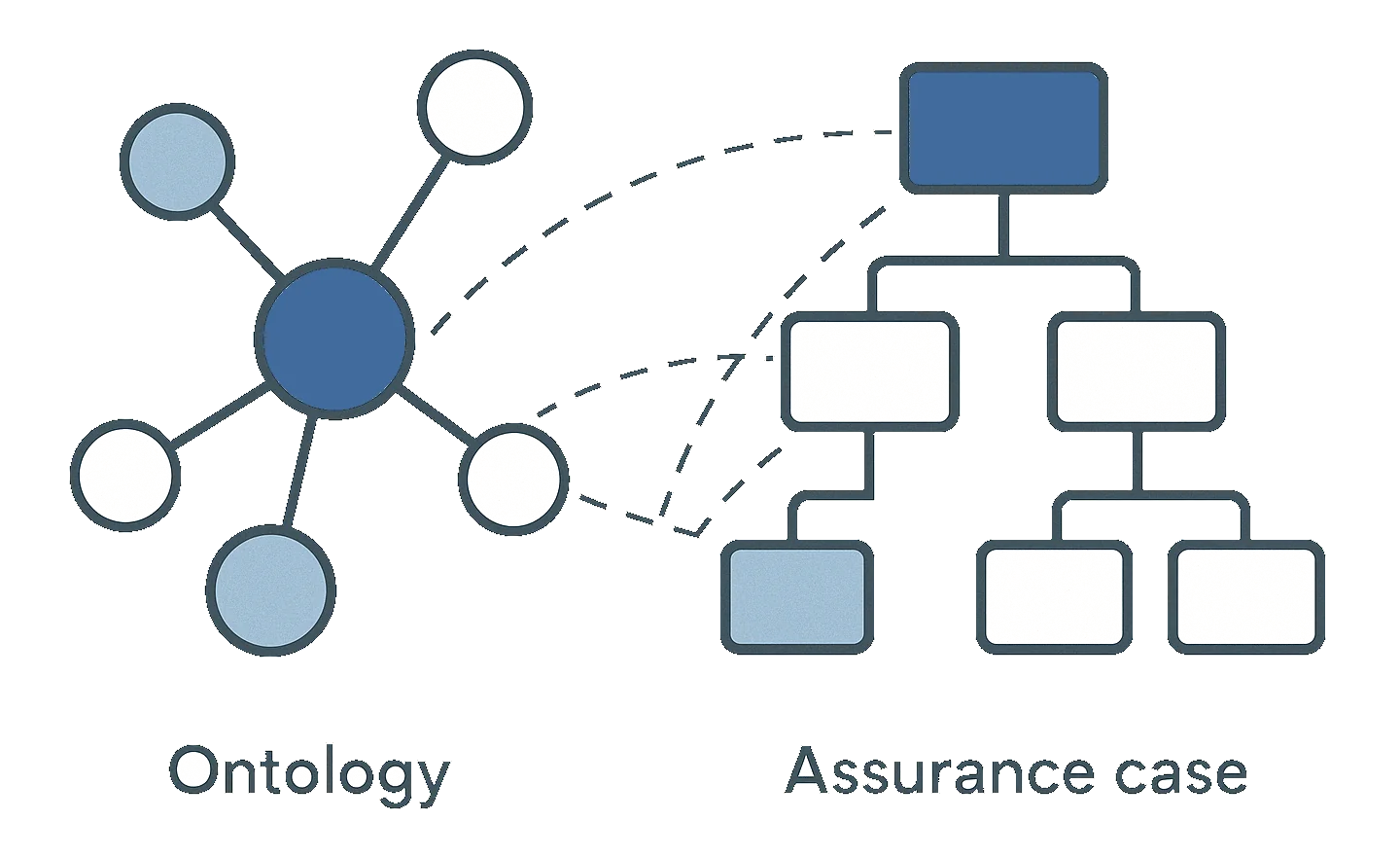
OntoGSN is an ontology for enabling users to manage (i.e., create, maintain, align, evaluate, explain and display) GSN assurance cases semantically.
What it gives you
-
Graph-native cases
Store and query assurance cases as graph data. Stored SPARQL queries answer common questions about a case.
-
Readable and visual
A human-readable representation of the domain that tools can draw as a tree.
-
One store for everything
Link claims and evidence to data, documents and code in one place.
-
Logic-based checks
SWRL rules for reasoners, the same rules as SPARQL updates for stores without one, and SHACL shapes for validating case data.
-
Ready for new methods
A foundation for advanced methods such as GraphRAG.
-
Open tooling
An active, mostly open-source ecosystem of editors, stores and reasoners.
Work with it
- Workbench
- In the browser
- Source
Grounded in the standard
Every term is sourced from the GSN Community Standard v3, across its five sections: core GSN and the argument pattern, modular, confidence and dialectic extensions. A design record traces each axiom to the passage of the standard behind it, and records the reasoning.
The ontology acts as a "translator" (i.e., middleware) between a system and its assurance case, and as a validator for the rules of the standard. You do not need to write a separate interface for each system, or update the assurance case by hand. Because the ontology carries the updates, you can follow the system's design, implementation, testing and runtime from the assurance case tree itself. This suits auditors, safety and security engineers, and other supervisory or monitoring roles.
How to cite
To cite the approach, cite the paper:
Bueno Momčilović, T., Gallina, B., Kessler, I., Hendricks, J., & Balta, D. (2025). OntoGSN: An Ontology-Based Framework for Semantic Management and Extension of Assurance Cases. arXiv preprint (v2). https://doi.org/10.48550/arXiv.2506.11023
To cite the ontology itself, for example a version that you use, cite the release:
Bueno Momčilović, T. (2026). OntoGSN (Version 1.3.0) [Ontology]. https://doi.org/10.5281/zenodo.17808330
- The paper
- a third version of the paper is in preparation
- The ontology
- this DOI always resolves to the newest release
Acknowledgements
Many thanks to:
- Prof. Barbara Gallina, Ingmar Kessler, and Dian Balta for contributions to the ontology and the paper;
- Jule Hendricks for contributions to the code;
- Yannick Landeck, Radouane Bouchekir, Tewodros Beyene, Carmen Carlan, and Laure Millet for reviewing various iterations of the contributions;
- Will Franks (Adelard / NCC Group) and Ewen Denney (NASA Ames) for providing access to the tools of their respective organizations;
- Damir Safin for technical support.
This work was partially supported by financial and other means by the following research projects: DUCA (EU grant agreement 101086308), DiProLeA (German Federal Ministry of Education and Research, grant 02J19B120 ff), ROBIN at the Bavarian Research Institute for Digital Transformation, ∞ COMPASS (#49 project at Software Center, Sweden), as well as our industrial partners in the FinComp project.